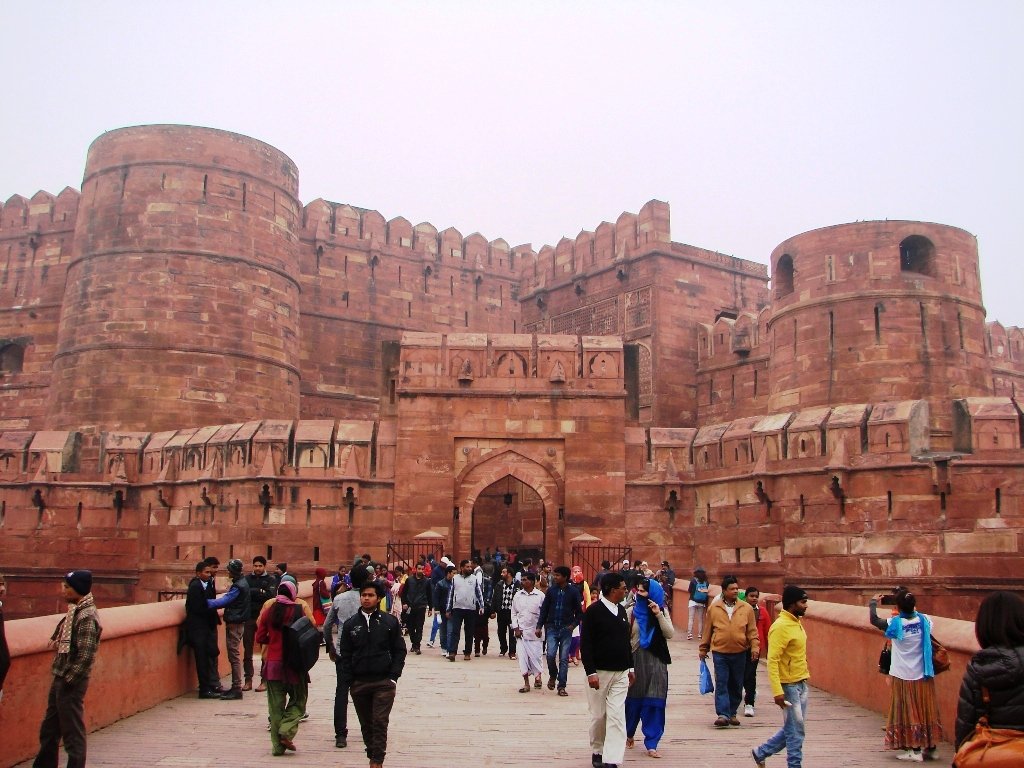
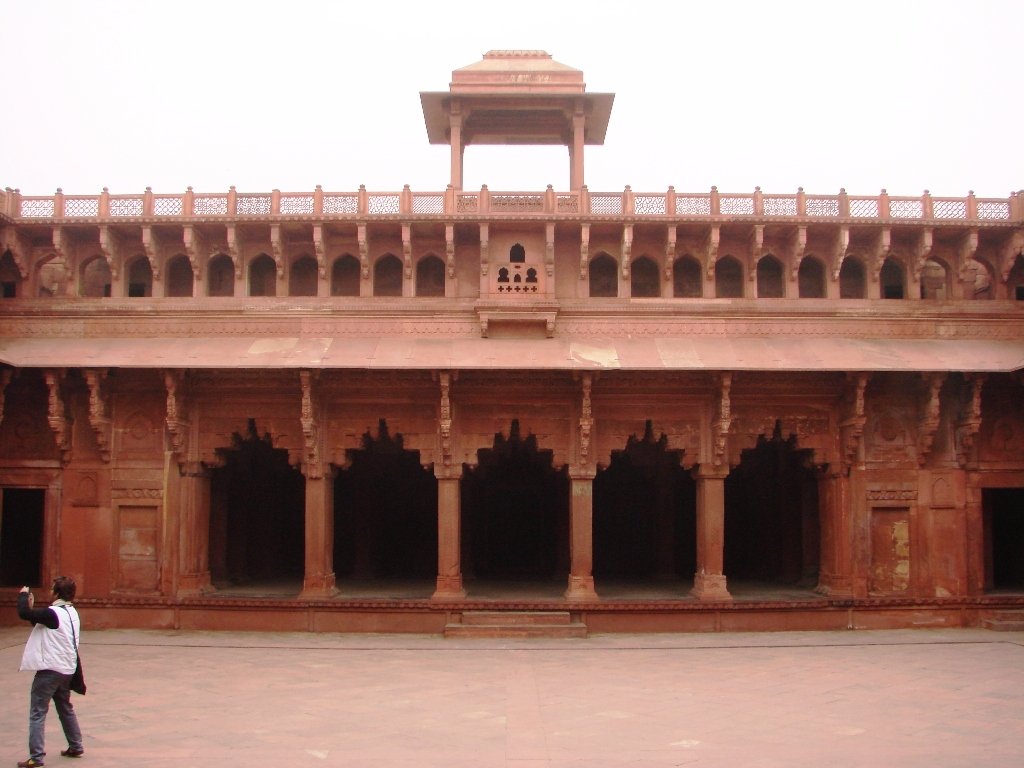
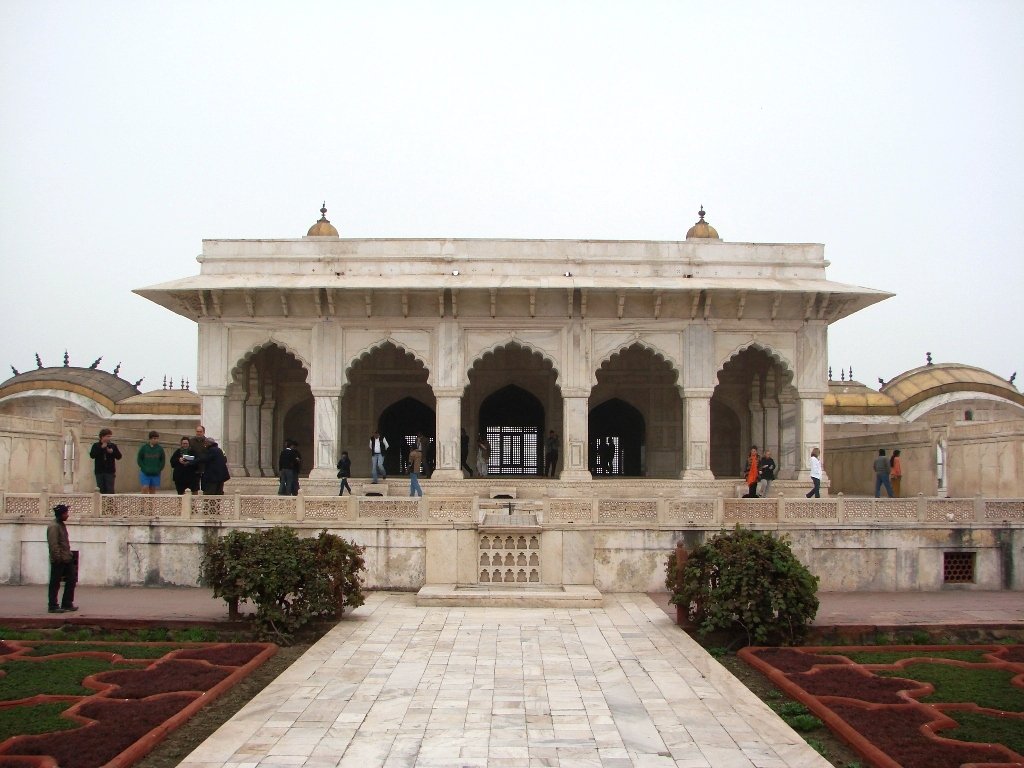
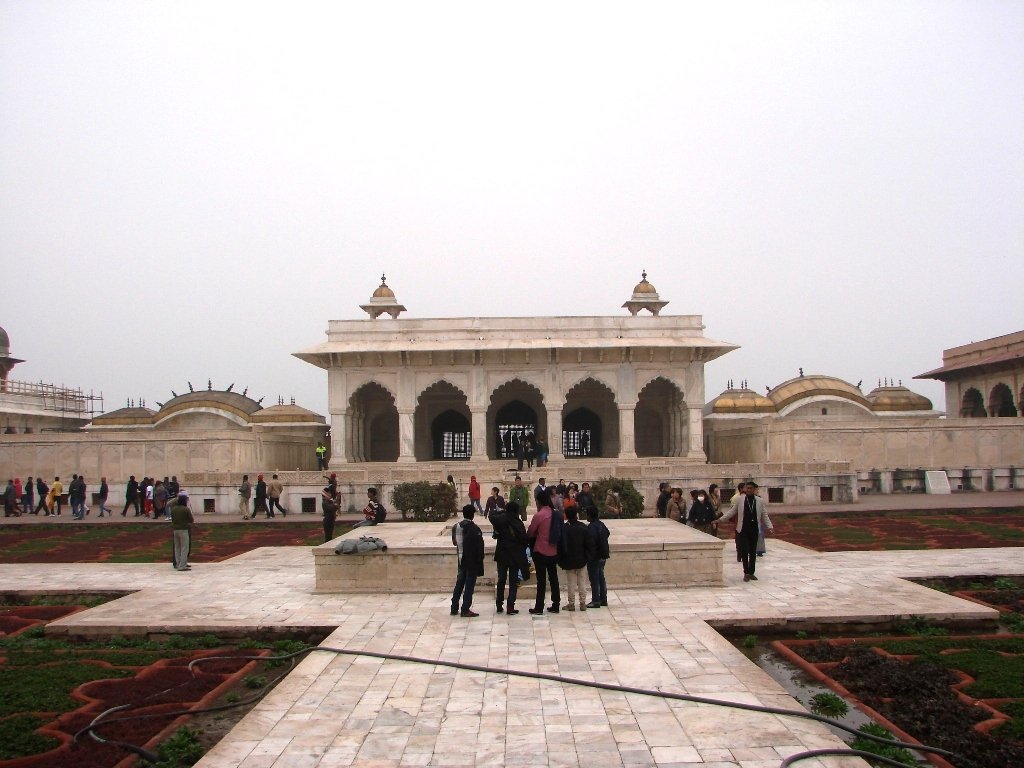
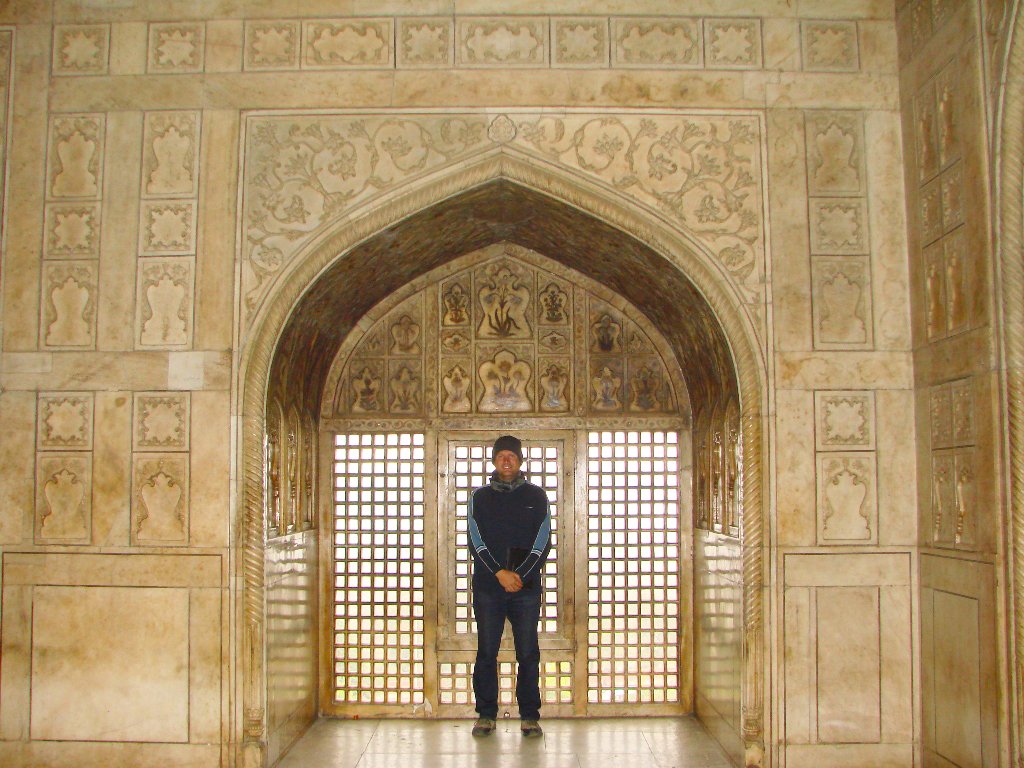
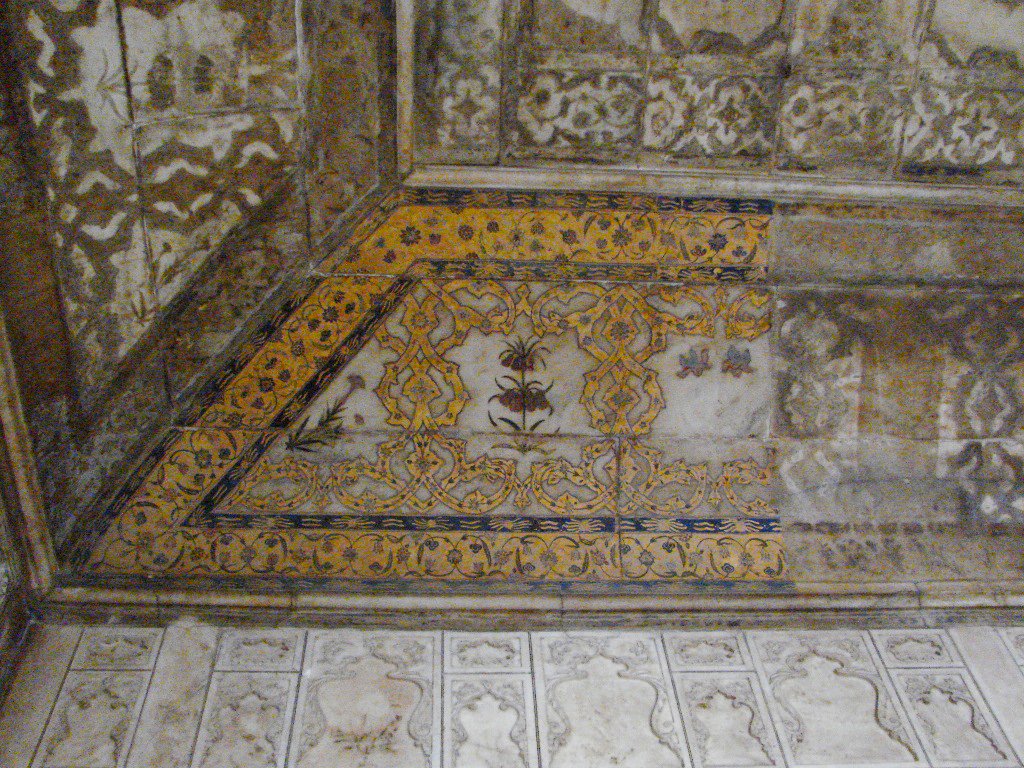
- Agra Fort was built primarily as a military structure by Akbar but was later transformed into a palace by his son, Shah Jahan
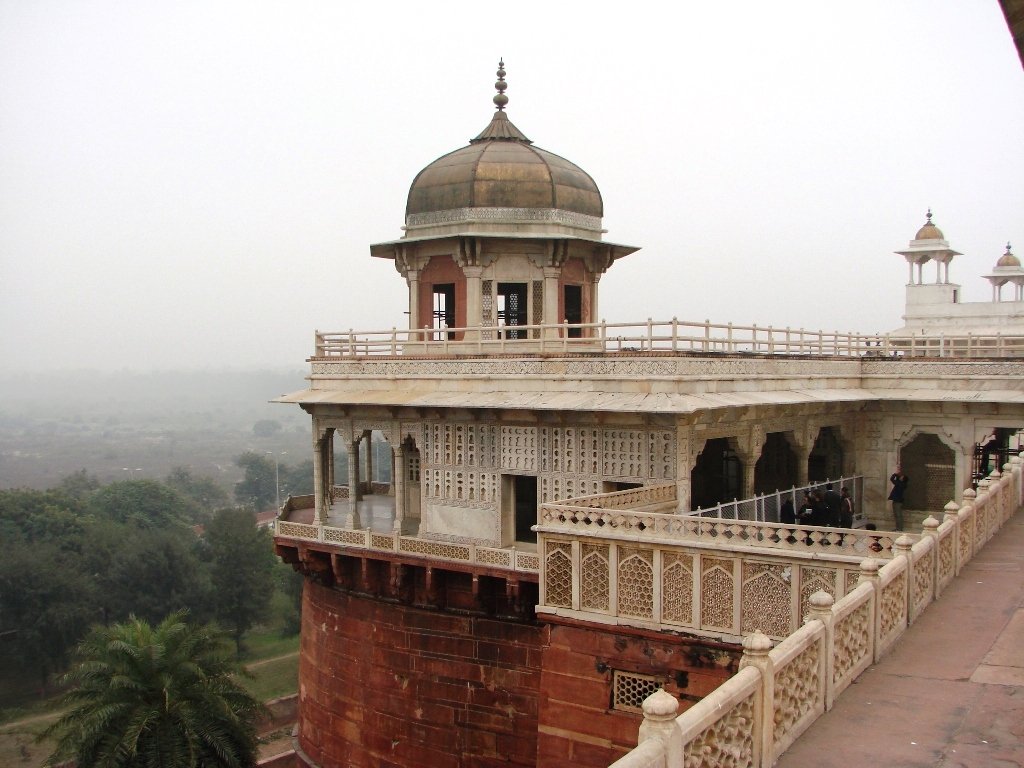
- Shah Jahan was imprisoned by his son Aurangzeb for eight years in the octagonal tower (known as ‘Mussaman Burj’) of Agra Fort
- Today you can see the Taj Mahal from Mussaman Burj as easily as Shah Jahan did centuries ago
- You can also see the Taj Mahal through the slits in the wall of Jodha Bai’s palace in Agra Fort
- Agra Fort was modelled after the Rajput fort built by Raja Man Singh Tomar of Gwalior in 1500
- In turn, the Agra Fort served as a model for Shah Jahan’s Red Fort in Delhi
- The Khas Mahal of the Agra Fort was the model for the Diwan-i-Khas at the Red Fort in Delhi
- The Yamuna River originally flowed along the straight eastern edge
of the fort, and the emperors had their own bathing ghats here
- The Diwan-i-Khas of Agra Fort once housed Shah Jahan’s legendary
Peacock Throne, which was inset with precious stones including the
famous Koh-i-noor diamond
- A large part of the Agra Fort was converted into army barracks by the British which are not accessible to the public
Choose
Red Fort Visit in Your Tour
Agra Fort History
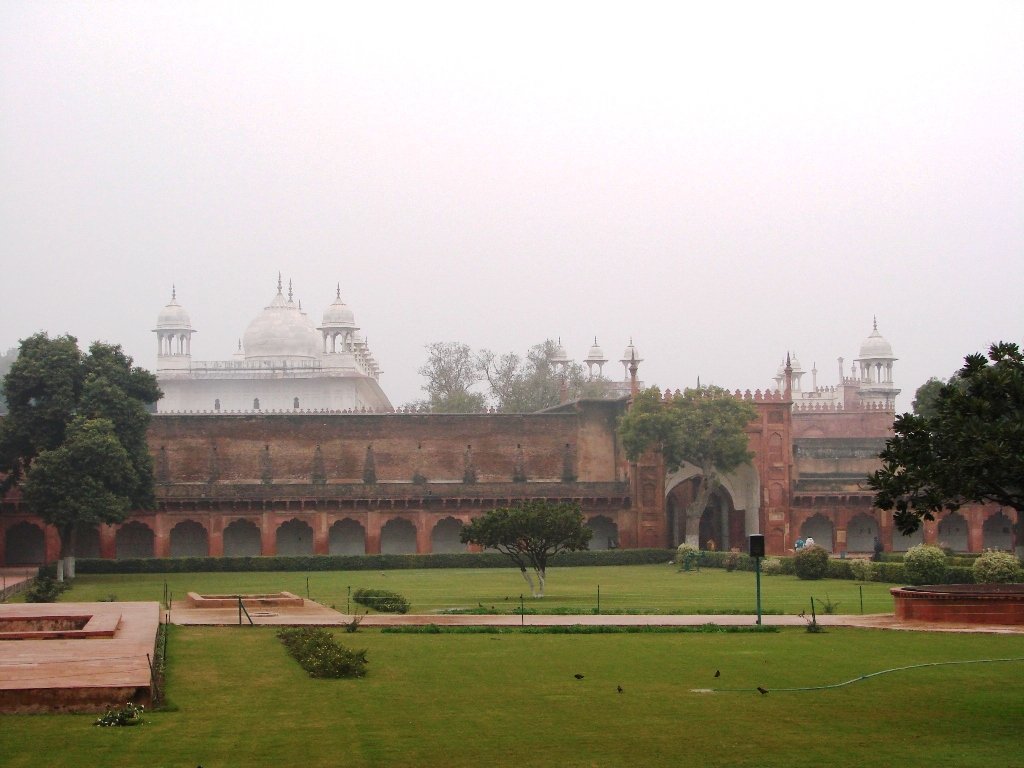
This massive red sandstone fort was built on the banks of the Yamuna
River in 1565 by Akbar, the first Mughal emperor in India. Further
improvements were made by his successors; Shah Jahan built the
impressive imperial quarters and mosque, while Aurangzeb added the outer
ramparts. The fort was built primarily as a military structure, but
Shah Jahan transformed it into a palace, and later it became his gilded
prison for eight years after his son Aurangzeb seized power in 1658.
The crescent-shaped fort’s colossal double walls rise over 20m in
height and measure 2.5km in circumference. It contains a maze of
buildings, forming a city within a city, including vast underground
sections, though many of the structures were destroyed over the years by
Nadir Shah, the Marathas, the Jats and finally the British, who used
the fort as a garrison. Even today, much of the fort is used by the
military and so is off -limits to the general public.
FAQs About Agra Fort
Below are the answers to a list of frequently asked questions about Agra Fort.
Who built Agra Fort?
Agra Fort was built by Akbar, the first Mughal emperor in
India. Further improvements were made by his successors; Shah Jahan
built the impressive imperial quarters and mosque, while Aurangzeb added
the outer ramparts.
When was Agra Fort built?
Agra Fort was built in 1565 on the banks of the Yamuna River.
Why was Agra Fort built?
Agra Fort was built by Akbar primarily as a military structure, but
his son, Shah Jahan transformed it into a palace, and later it became
his gilded prison for eight years after his son Aurangzeb seized power
in 1658.
Where is Agra Fort located?
Agra Fort is located on the western banks of the Yamuna River in the
northern Indian city of Agra in Uttar Pradesh, India. In terms of
distance, it is only 1.4 km from the Agra city centre.
How to get to and from Agra Fort?
If you’re staying at Taj Ganj or elsewhere in Agra, the best way to
get to and from Agra Fort is to take an auto rickshaw there. If you’re
coming from Delhi by train, get off at Agra Fort station which is right
in front of the fort. Alternatively, you can hire a private car with
chauffeur from Delhi or Agra for the day to take you to the sites.
Agra Fort Timings
Agra Fort is open daily from 6 am to 6 pm.
Agra Fort Entrance Fee
The entrance fee for Agra Fort is Rs 20 for Indians and Rs 300 for
foreigners. There are no extra charges for carrying a still or video
camera inside Agra Fort.
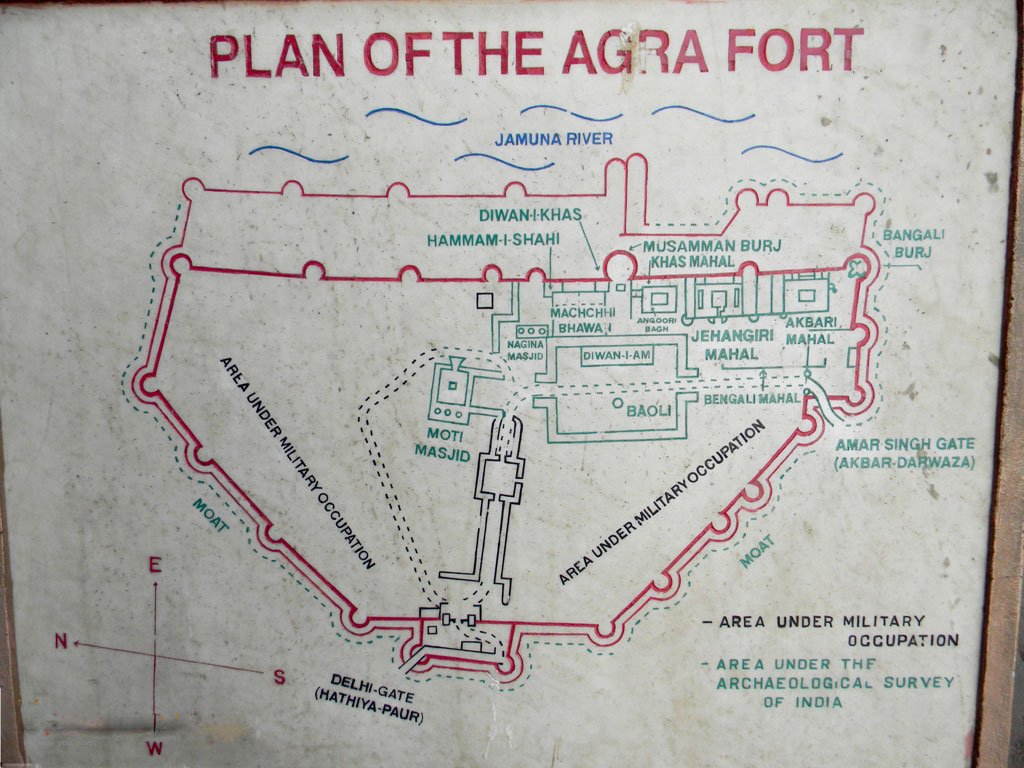
Agra Fort Map
Detailed Information About Agra Fort
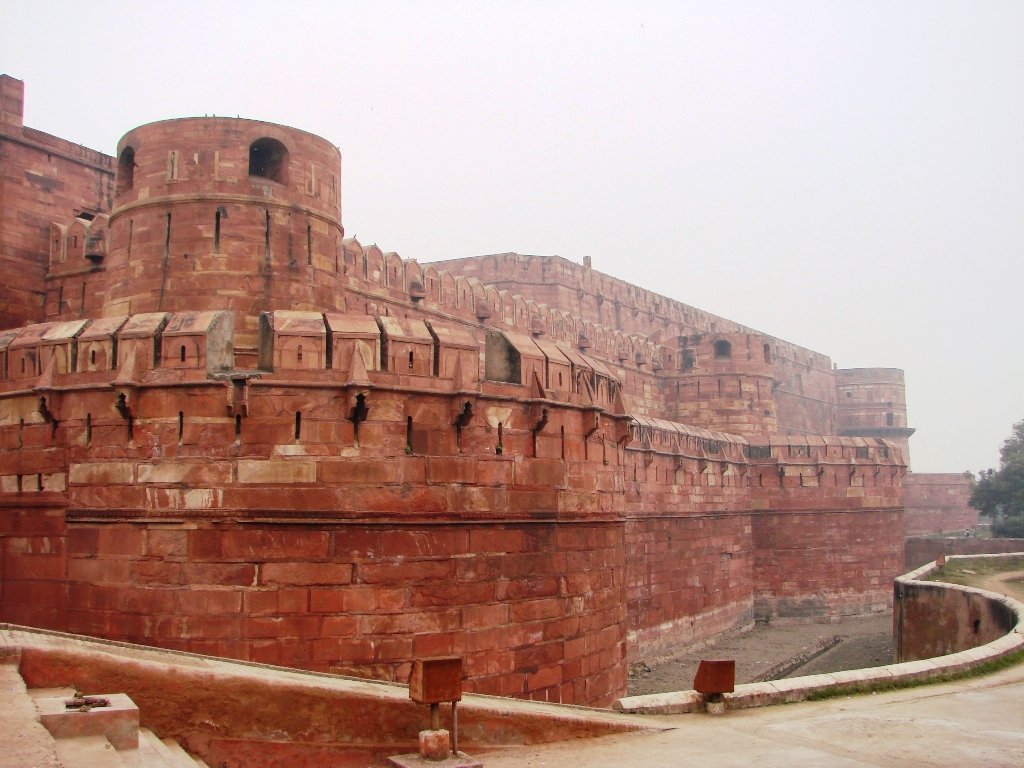
Fortifications of Agra Fort
The fortifications tower above the 9-m-wide, 10-m-deep moat (still
evident but containing stagnant water) was formerly filled with water
from the Yamuna River. There is an outer wall on the riverside and an
imposing 22-m-high inner, main wall, giving a feeling of great defensive
power. If an aggressor managed to get through the outer gate they would
have to make a right-hand turn and thereby expose their flank to the
defenders on the inner wall.
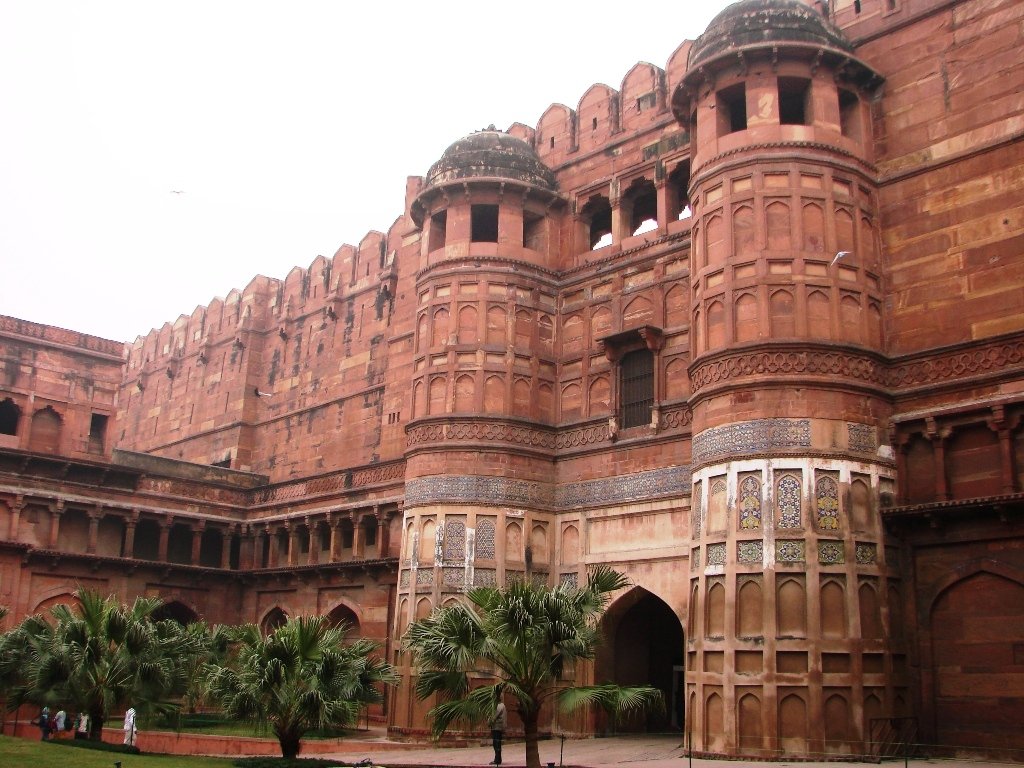
The inner gate is solidly powerful but has been attractively
decorated with tiles. The similarities with Islamic patterns of the
tilework are obvious, though the Persian blue was also used in the
Gwalior Fort and may well have been imitated from that example. The
incline up to this point and beyond was suitable for elephants and as
you walk past the last gate and up the broad brick-lined ramp with
ridged slabs, it is easy to imagine arriving on elephant back.
At the top of this 100-m ramp is the impressive
Amar Singh Gate
with a map and description board on your left. This is the only entry
point to the fort these days and where you buy your entrance ticket.
Jahangiri Mahal
Although some believe that this palace was built by Akbar for his son
Jahangir, it was built by Akbar (circa 1570) as women’s quarters. It is
all that survives of his original palace buildings. With a complex
arrangement of halls, courtyards and galleries, with dungeons
underneath, this was the
zenana or main harem.
In front of the palace is
Hauz-i-Jahangir, a large
bowl carved out of a single block of stone, with steps both inside and
outside, which, according to legend, used to be filled in Nur Jahan’s
time with thousands of rose petals so that the empress could bathe in
its scented waters.
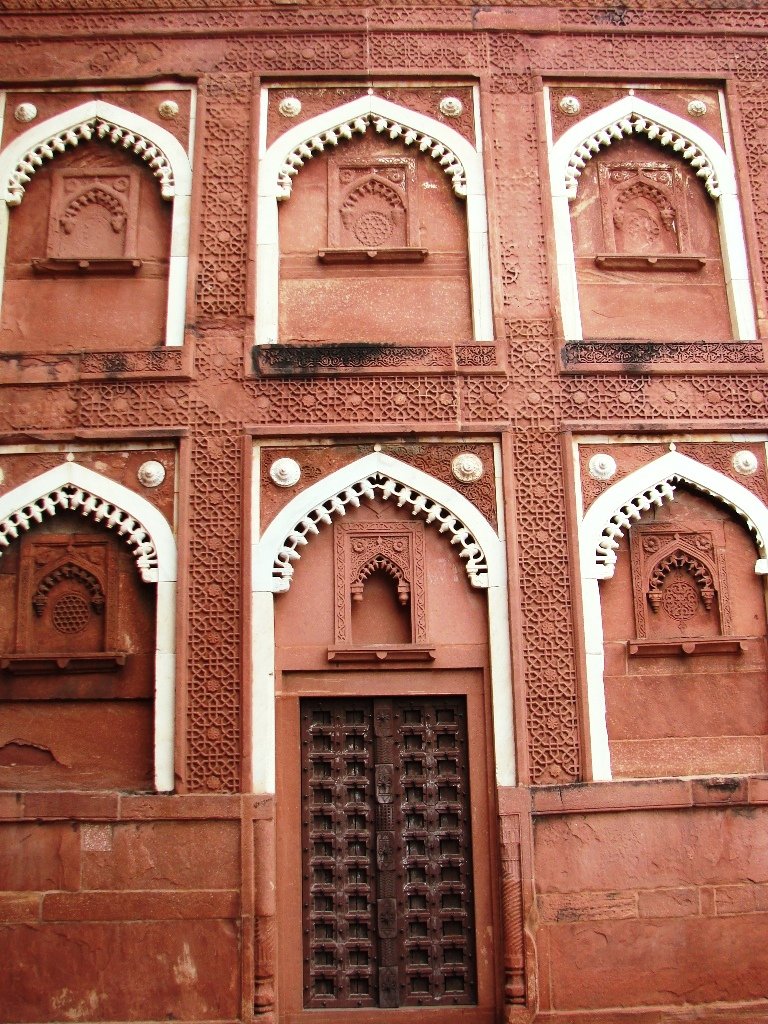
Almost 75 m sq, the palace has a simple stone exterior. Tillotson has
pointed out that the blind arcade of pointed arches inlaid with white
marble which decorate the façade is copied from 14th-century monuments
of the Khaljis and Tughluqs in Delhi. He notes that they are
complemented by some features derived from Hindu architecture, including
the
jarokhas (balconies) protruding from the central section, the sloping dripstone in place of
chajja (eaves) along the top of the façade, and the domed
chhattris
at its ends. The presence of distinctively Hindu features does not
indicate a synthesis of architectural styles at this early stage of
Mughal architecture, as can be seen much more clearly from inside the
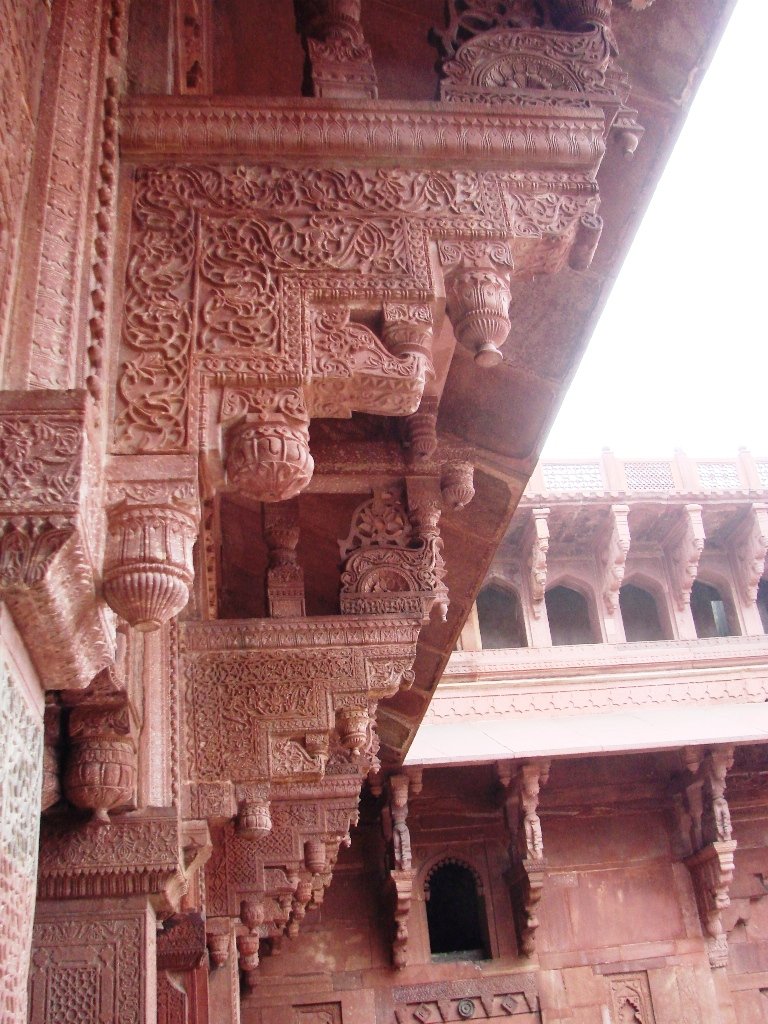
Jahangiri Mahal. Here most of the features are straightforwardly Hindu;
square-headed arches and extraordinarily carved capitals and brackets
illustrate the vivid work of local Hindu craftsmen employed by Akbar
without any attempt either to curb their enthusiasm for florid
decoration and mythical animals nor to produce a fusion of Hindu and
Islamic ideas. Tillotson argues that the central courtyard is
essentially Hindu, in significant contrast with most earlier
Indo-Islamic buildings. In these, an Islamic scheme was modified by
Hindu touches. He suggests, therefore, that the Jahangiri Mahal marks
the start of a more fundamental kind of Hinduization, typical of several
projects during Akbar’s middle period of rule, including the palace
complex in Fatehpur Sikri. However, it did not represent a real fusion
of ideas – something that only came under Shah Jahan – simply a
juxtaposition of sharply contrasting styles.
Jodha Bai’s Palace
Located on the south side, this palace is named after Jodha Bai, one
of Jahangir’s wives. On the east, the hall court leads onto a more open
yard by the inner wall of the fort. In contrast to other palaces in the
fort, this palace is quite simple. Through the slits in the wall you can
see the Taj.
Shah Jahan’s Palace Buildings
Turn left through to Shah Jahan’s Khas Mahal built in 1636. The open
tower allows you to view the walls and see the decorated Mussaman Burj
tower to your left. The use of white marble transforms the atmosphere,
contributing to the new sense of grace and light.
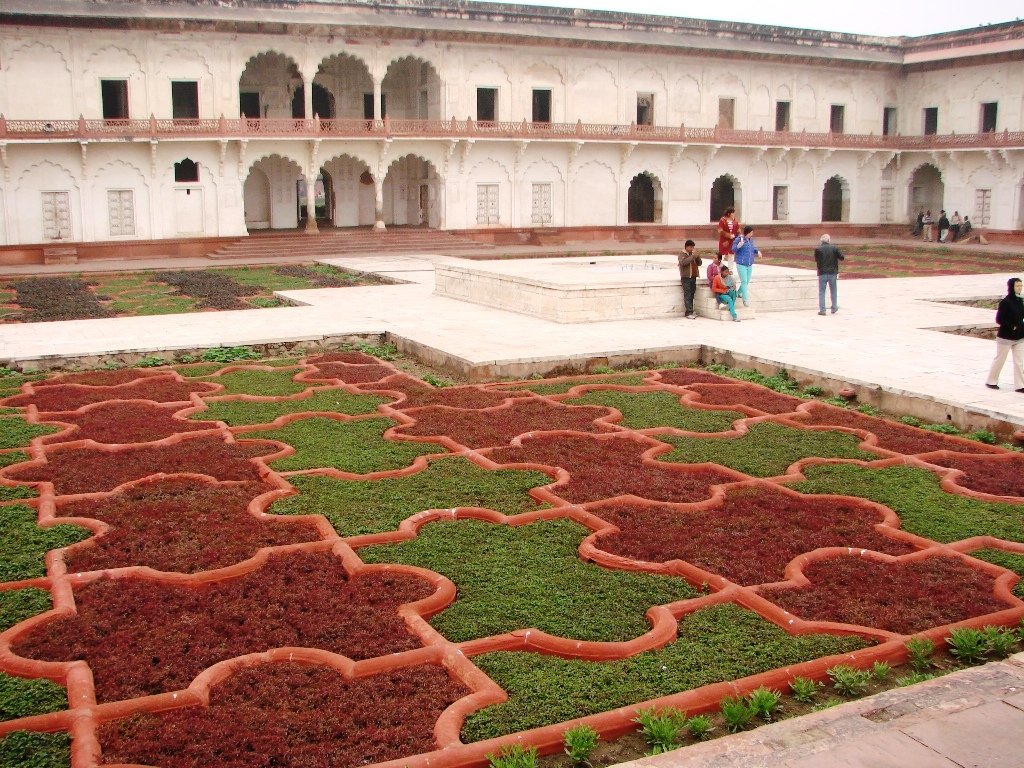
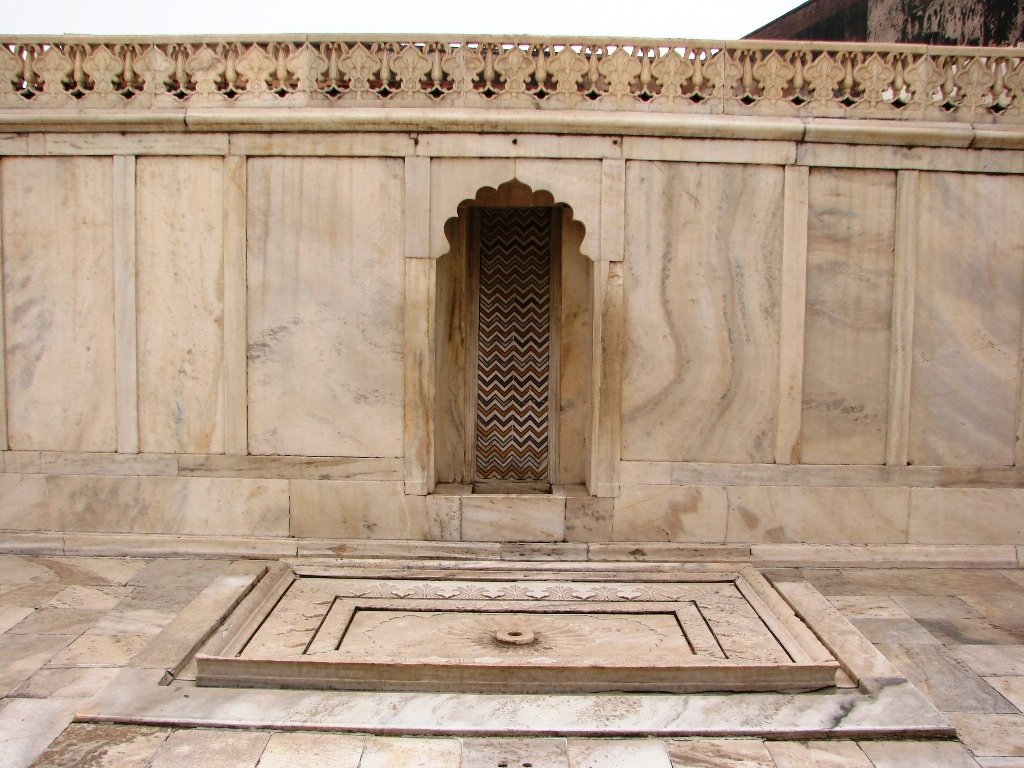
Anguri Bagh
On the left is Anguri Bagh (“Grape Garden”) with its formal, 85-sq-m,
geometric gardens. In Shah Jahan’s time the geometric patterns were
enhanced by decorative flower beds. In front, there is a decorative
water slide in the middle of the white marble platform wall. With its
bays for seating and its fountains, water from the pool would drain off
along channels decorated to mimic a stream. The surface was scalloped to
produce a rippling waterfall, or inlaid with jewels to create a
shimmering stream bed. Behind vertical water drops, there are little
cusped arch niches into which flowers would be placed during the day and
lamps at night. This effect transformed the area into a fantasy garden.
Golden Pavilions
Next to the Khas Mahal are two small pavilions with
bangaldar
roofs (curved roofs derived from Bengali village huts constructed out
of curved bamboo, designed to keep off heavy rain). The shape was first
expressed in stone by the Sultans of Bengal.
Originally gilded, these were probably ladies’ bedrooms and have
narrow niches in the walls which could have been used to conceal
jewellery. These pavilions were once associated with the princesses
Jahanara and Roshanara, before the latter plotted the downfall of her
father and sister.
Khas Mahal
This was the model for the Diwan-i-Khas at the Red Fort in Delhi.
Some of the original interior decoration were restored in 1895 and gives
an impression of how splendid the painted ceiling must have been. The
metal rings were probably used for punkhas (ceiling fans). Underneath
are cool rooms used to escape the summer heat. The Khas Mahal
illustrates Shah Jahan’s original architectural contribution.
The buildings retain distinctively Islamic Persian features – the
geometrical planning of the pavilions and the formal layout of the
gardens, for example. Tillotson points out that here “Hindu motifs are
treated in a new manner, which is less directly imitative of the Hindu
antecedents. The temple columns and corbel capitals have been stripped
of their rich carving and turned into simpler, smoother forms … the
chhattris have Islamic domes. Through these subtle changes the
indigenous motifs have lost their specifically Hindu identity; they
therefore contrast less strongly with the Islamic components, and are
bound with them into a new style. The unity is assisted by the use of
the cusped arch and the Bangladar roof”. Seen in this light, the Khas
Mahal achieves a true synthesis which eluded Akbar’s designs.
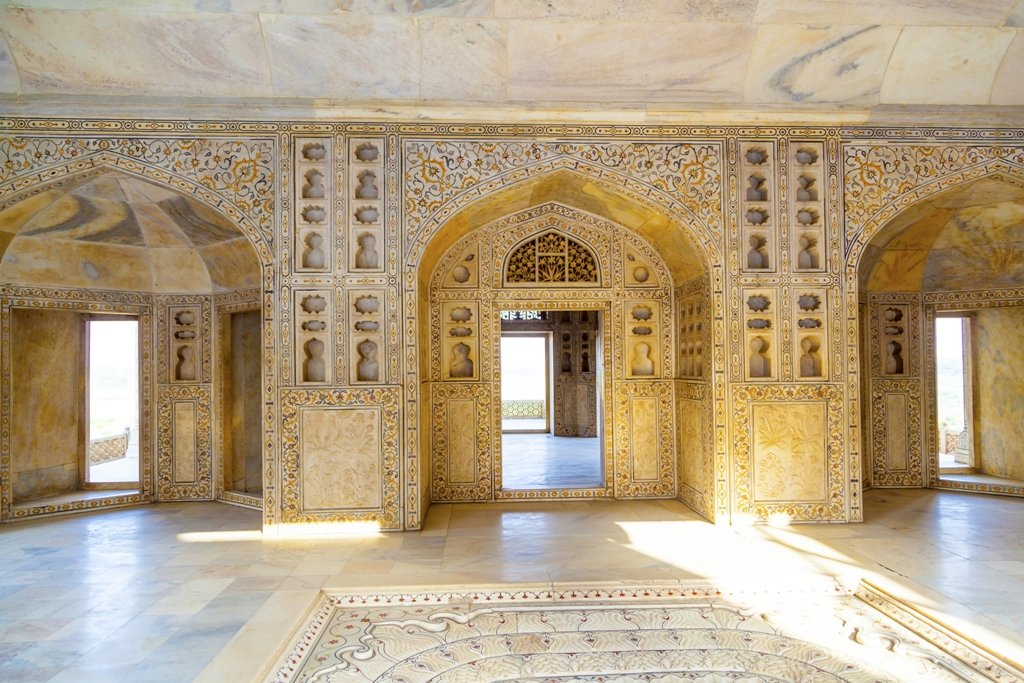
Mussaman Burj
On the left of the Khas Mahal is the Mussaman Burj (“Octagonal
Tower”) where Shah Jahan was later imprisoned by his son, Aurangzeb for
eight years until his death in 1666, and from where he could gaze out at
the Taj Mahal, the tomb of his wife. It is a wonderful white-marble
double storeyed octagonal tower and palace with an open pavilion. With
its openness, elevation and the benefit of cooling evening breezes
blowing in off the Yamuna River, this could well have been used as the
emperor’s bedroom. It has been suggested that this is where Shah Jahan
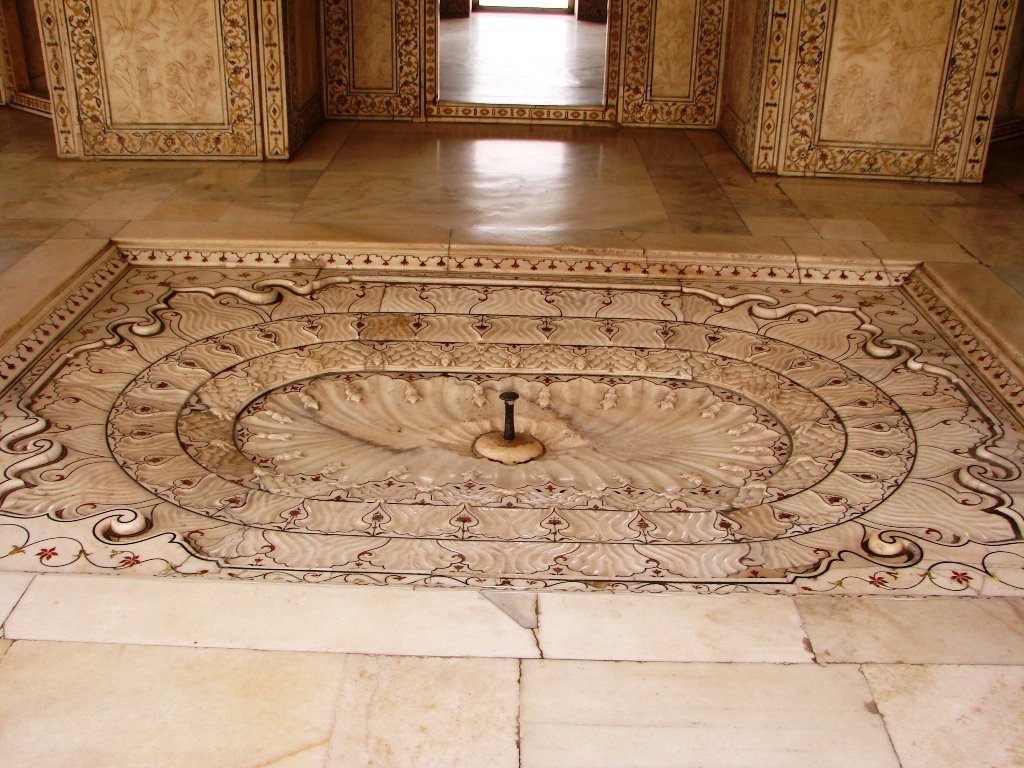
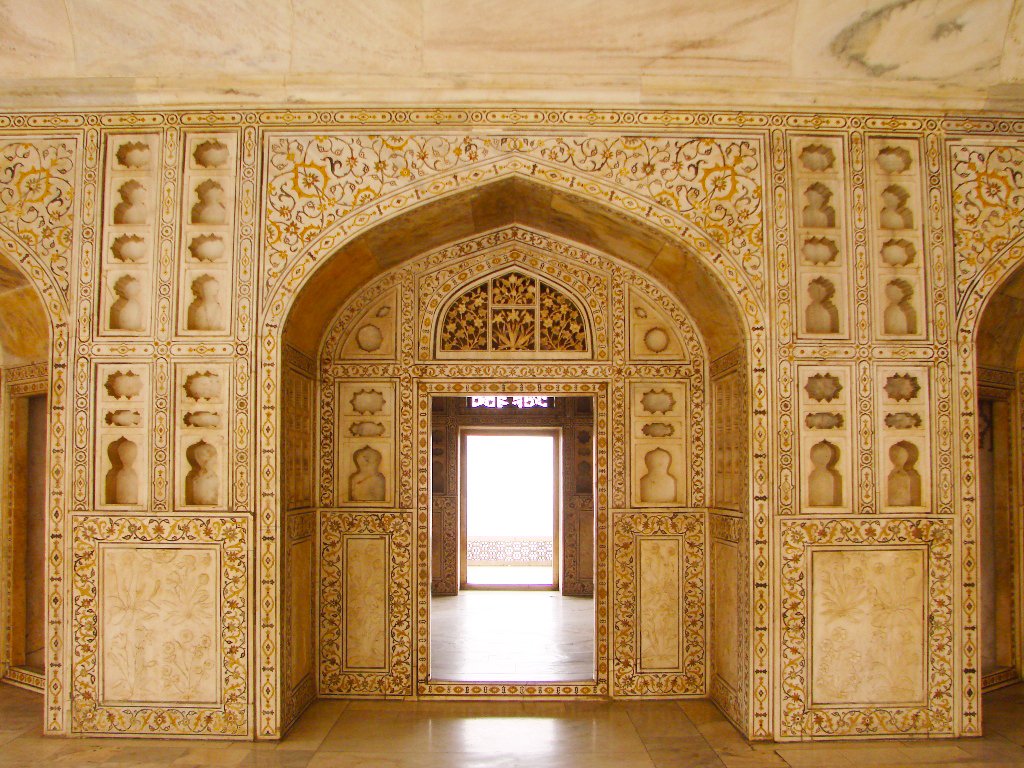
lay on his deathbed, gazing at the Taj. Access to this tower is through a
magnificently decorated and intimate apartment with a scalloped
fountain in the centre. The inlay work here is exquisite, especially
above the pillars. In front of the fountain is a sunken courtyard which
could be filled by water carriers, to work the fountains in the pool.
Sheesh Mahal
Sheesh Mahal (“Mirror Palace”) is another example of decorative water
engineering in the hammams; the water here may have been warmed by
lamps. The mirrors, which were more precious than marble, were set into
the walls, often specially chiselled to accommodate their crooked shape.
The defensive qualities of the site and the fortifications are obvious.
In the area between the outer rampart and the inner wall gladiatorial
battles were staged pitting man against tiger, or elephant against
elephant. The tower was the emperor’s grandstand seat.
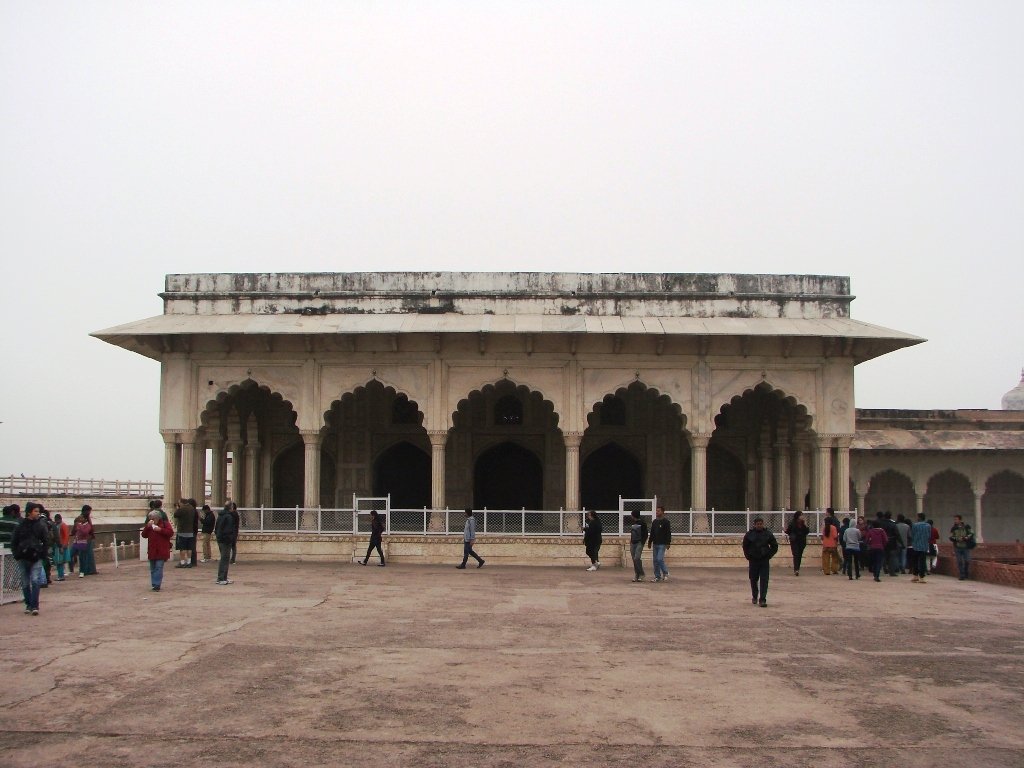
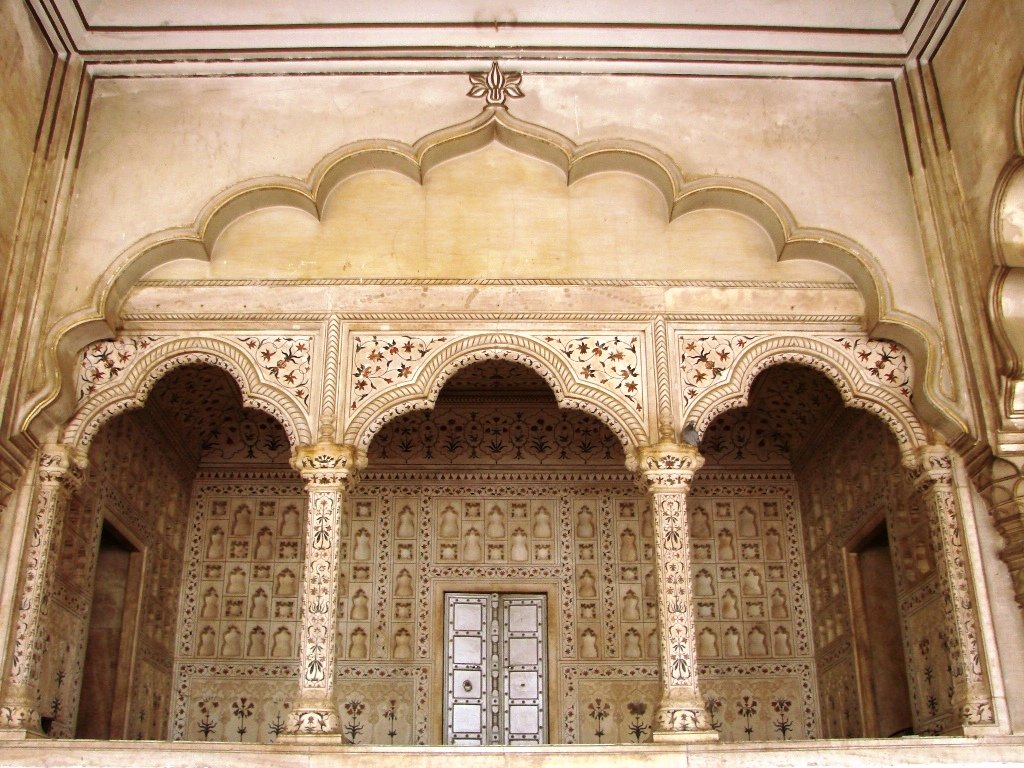
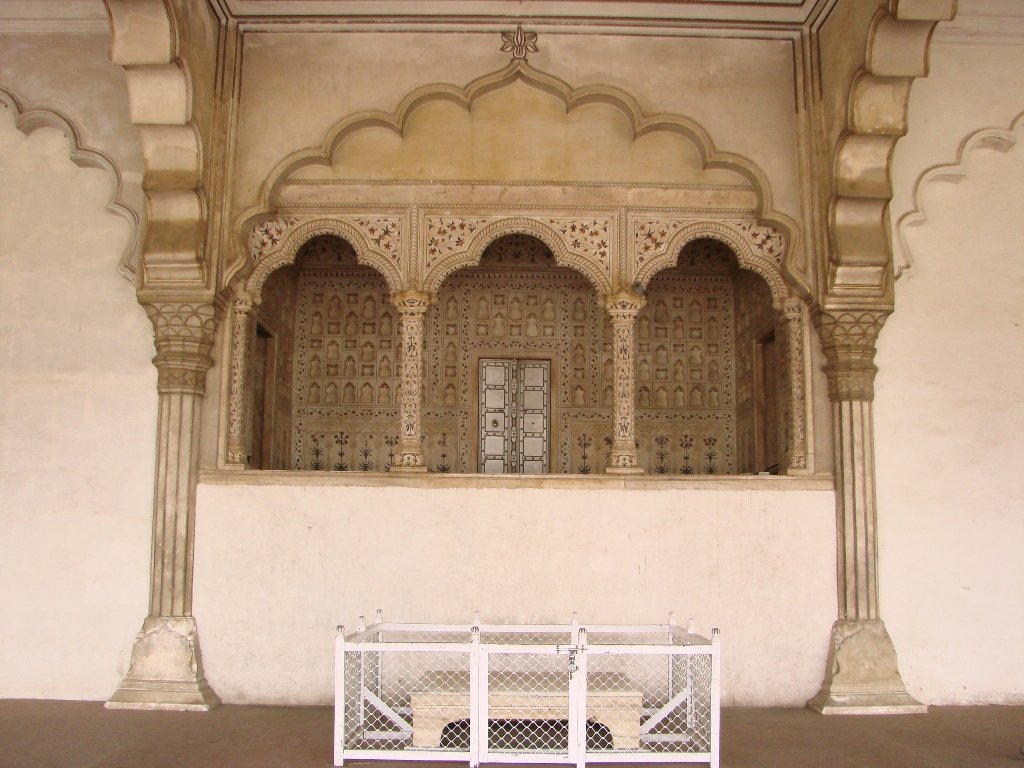
Diwan-i-Khas
Built in 1637 next to the Mussaman Burj, the Hall of Private Audience
is approached by a staircase which brings you out at the side. A
three-sided pavilion with a terrace of fine proportions, the
Diwan-i-Khas was reserved for important dignitaries or foreign
representatives. The interior would have been richly decorated with
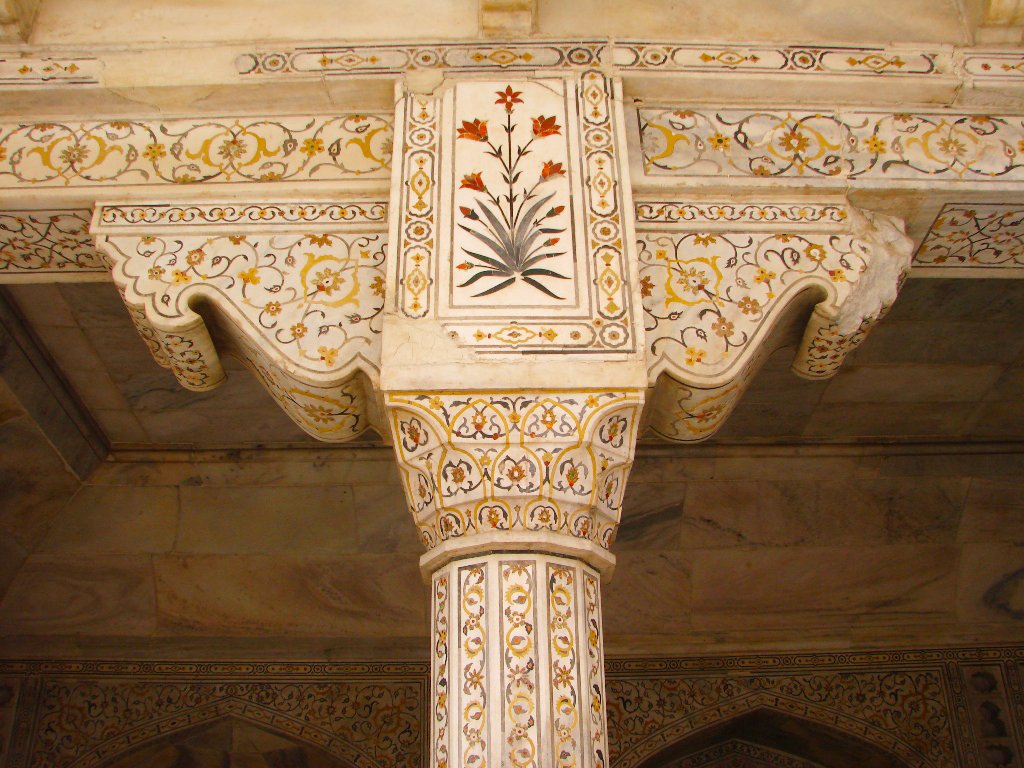
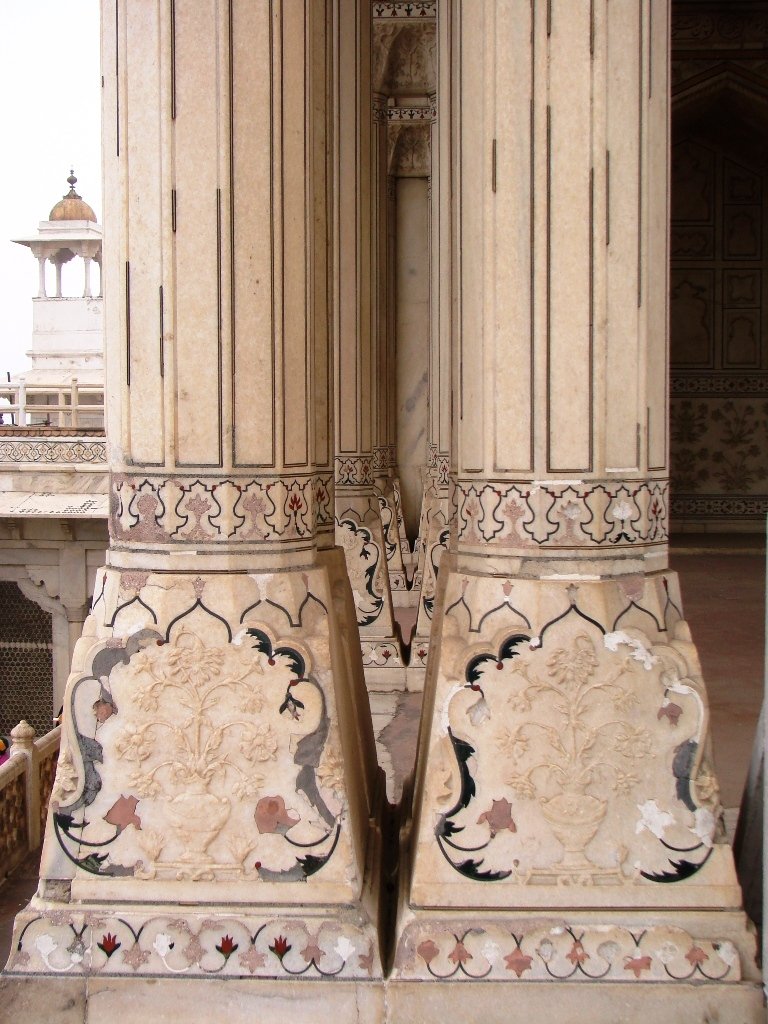
tapestries and carpets. The double marble columns with finely carved
capitals would have been inlaid with semi-precious stones in delightful
floral patterns in
pietra dura. The hall once housed Shah
Jahan’s legendary Peacock Throne, which was inset with precious stones
including the famous Koh-i-noor diamond. The throne was taken to Delhi
by Aurangzeb, then to Iran in 1739 by Nadir Shah and dismantled after
his assassination in 1747.
Terrace and Machhi Bhavan
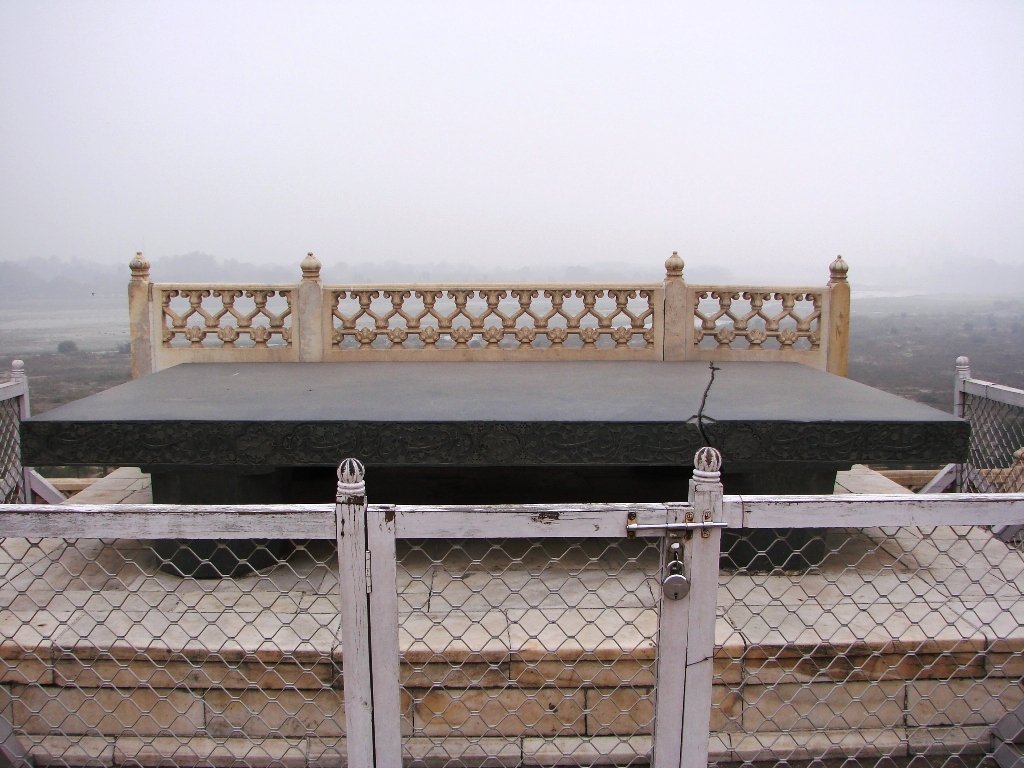
In front of the Diwan-i-Khas are two throne ‘platforms’ on a terrace. Overlooking the river and the distant Taj Mahal is
Takhti-i-Jahangir,
a huge slab of black rock with an inscription around the edge. The
throne that stood here was made for Jahangir when he was Prince Salim.
Gascoigne recounts how Shah Jahan tried to trick a haughty Persian
ambassador into bowing low as he approached the throne by erecting a
fence with a small wicket gate so that his visitor would have to enter
on hands and knees. The ambassador did so, but entered backwards, thus
presenting his bottom first to the Emperor. The black marble throne at
the rear of the terrace was used by Jahangir when claiming to be Emperor
at Allahabad. The emperor sat on the white marble platform facing the
Machhi Bhavan
(Fish Enclosure), a water palace which once contained pools and
fountains, waiting to meet visiting dignitaries or to watch elephant
fights below.
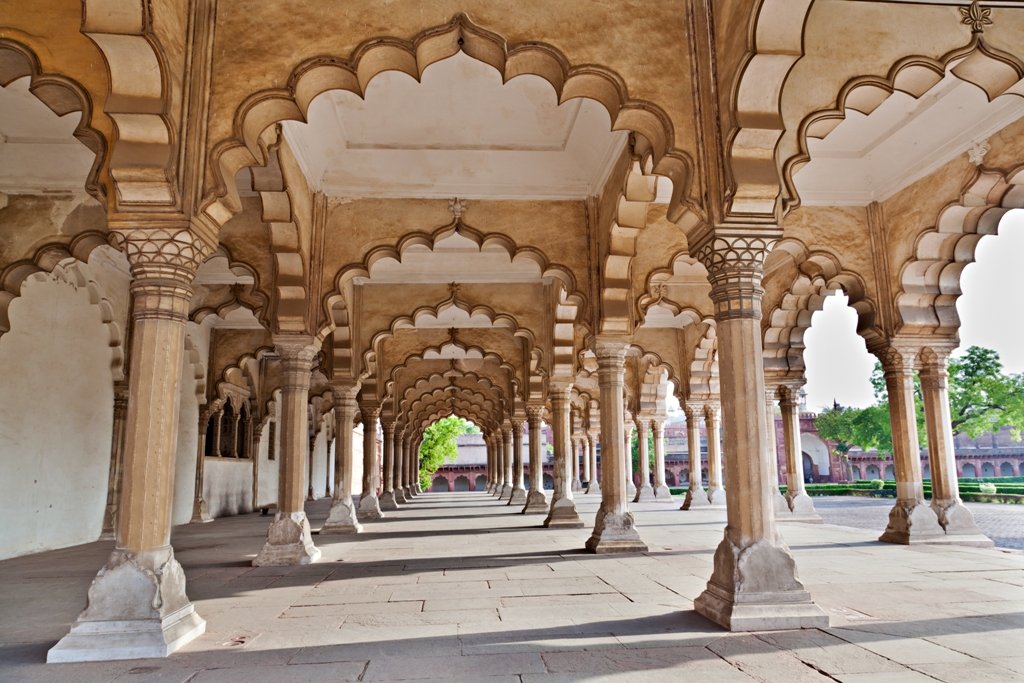
Diwan-i-Am

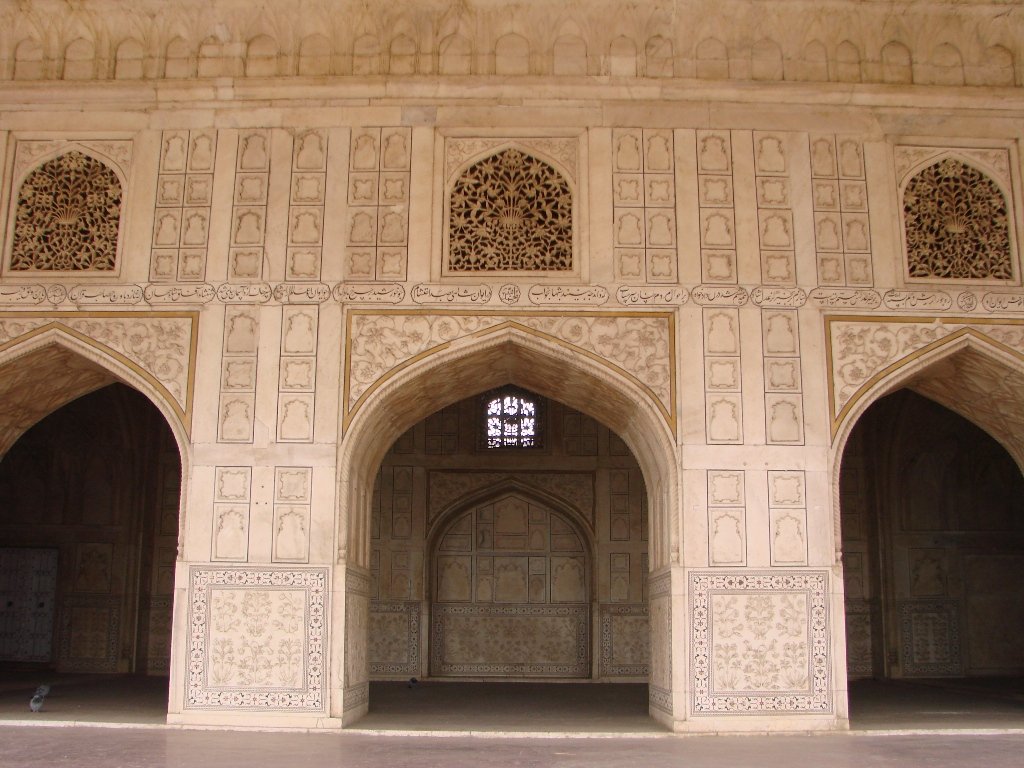
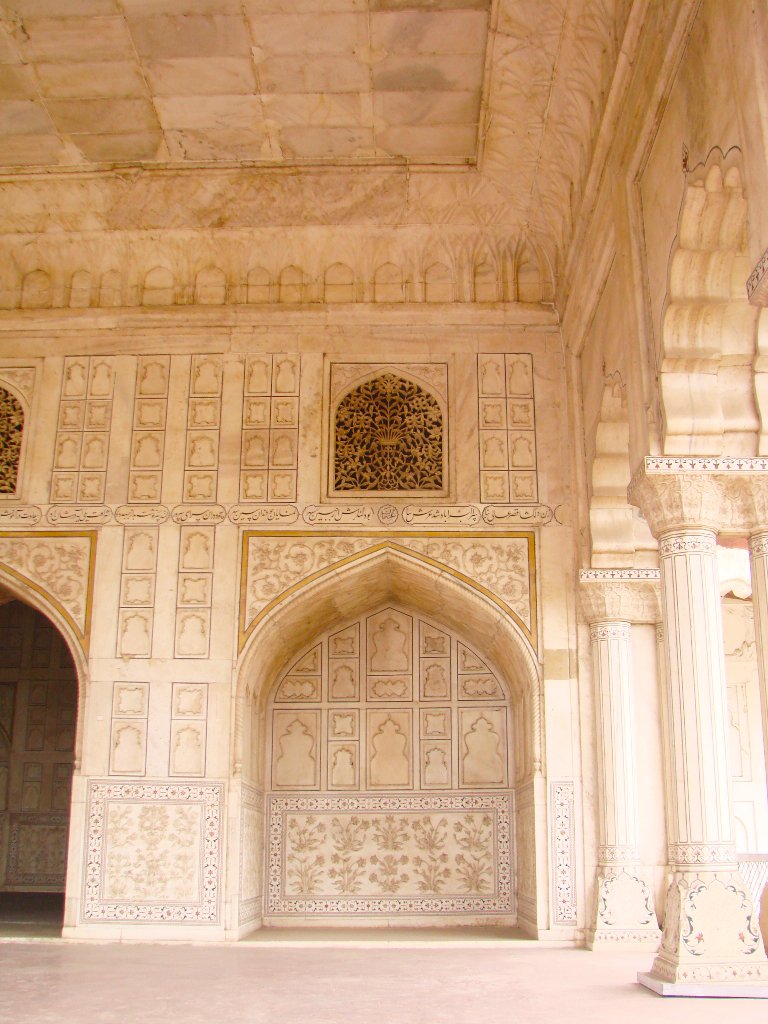
An internal staircase leads to the Diwan-i-Am which was used by Shah
Jahan for domestic government business, and features a throne room where
the emperor listened to petitioners. The clever positioning of the
pillars gives the visitor an uninterrupted view of the throne as they
arrive through the gates situated in the right- and left-hand walls of
the courtyard. The back wall of the pavilion has jali screens to enable
the women of the court to watch the activities without being seen. The
open-sided, cusped arched hall built of plaster on red sandstone, is
very impressive. Made of white marble and richly decorated, the alcove
that housed the Peacock Throne was completed in 1634 and took seven
years to build. Its decoration made it extraordinary: “the canopy was
carved in enamel work and studded with individual gems, its interior was
thickly encrusted with rubies, garnets and diamonds, and it was
supported on 12 emerald covered columns” writes Tillotson. When Shah
Jahan moved his capital to Delhi he took the throne with him to the Red
Fort, only for it to be taken back to Persia when it was looted by Nadir
Shah in 1739.
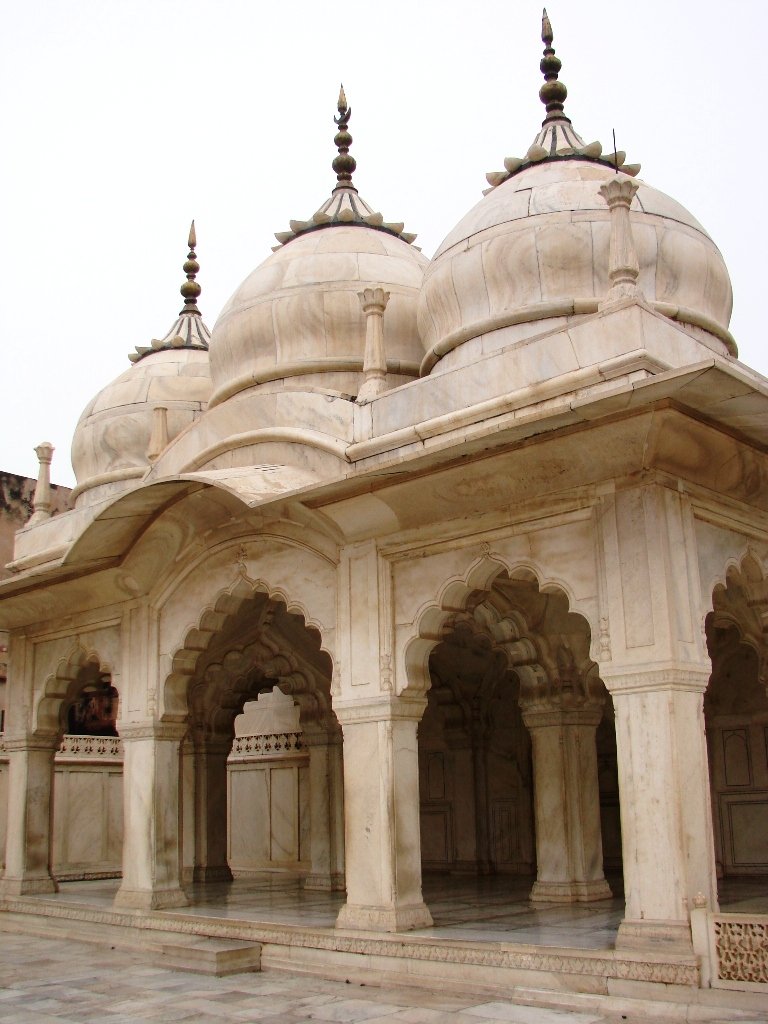
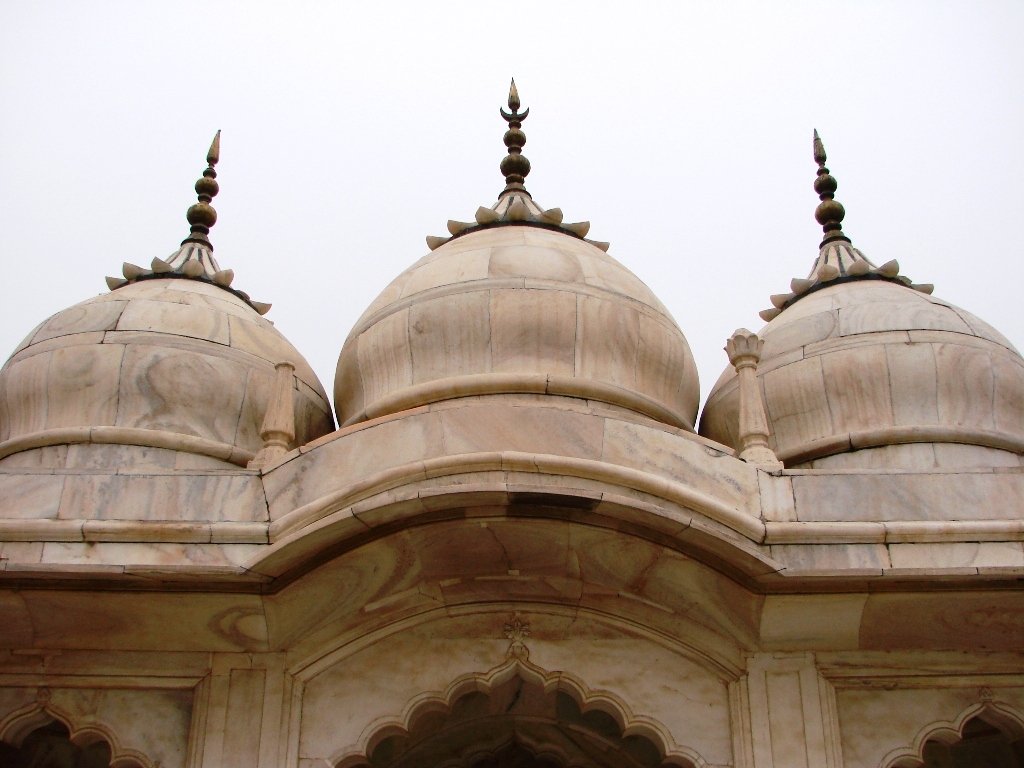
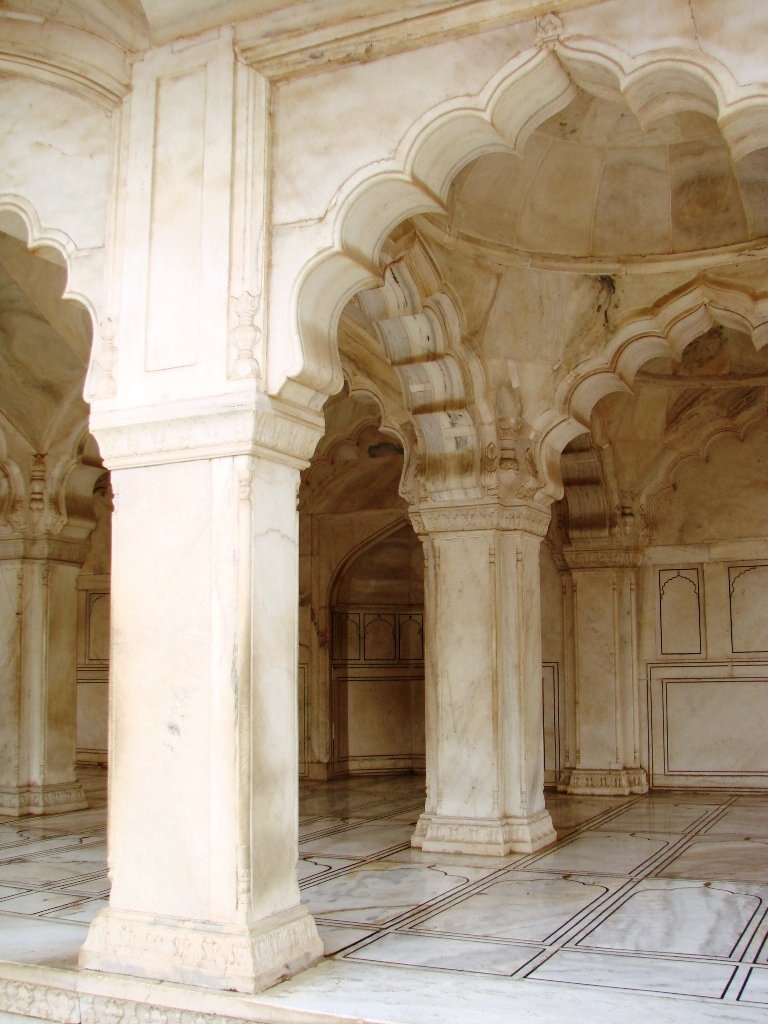
Nagina Masjid
From the corner opposite the Diwan-i-Khas two doorways lead to a view
over the small courtyards of the zenana (harem). Further round in the
next corner is the tiny but exquisite Nagina Masjid (“Gem Mosque”).
Built in 1635 by Shah Jahan, this was the private mosque of the ladies
of the court. Shoes must be removed at the doorway before entering.
Beneath it was a
Mina Bazaar for the ladies to make
purchases from the marble balcony above. Looking out of the Diwan-i-Am
you can see the domes of the Moti Masjid (“Pearl Mosque”, 1646-1653), an
extremely fine building closed to visitors because of structural
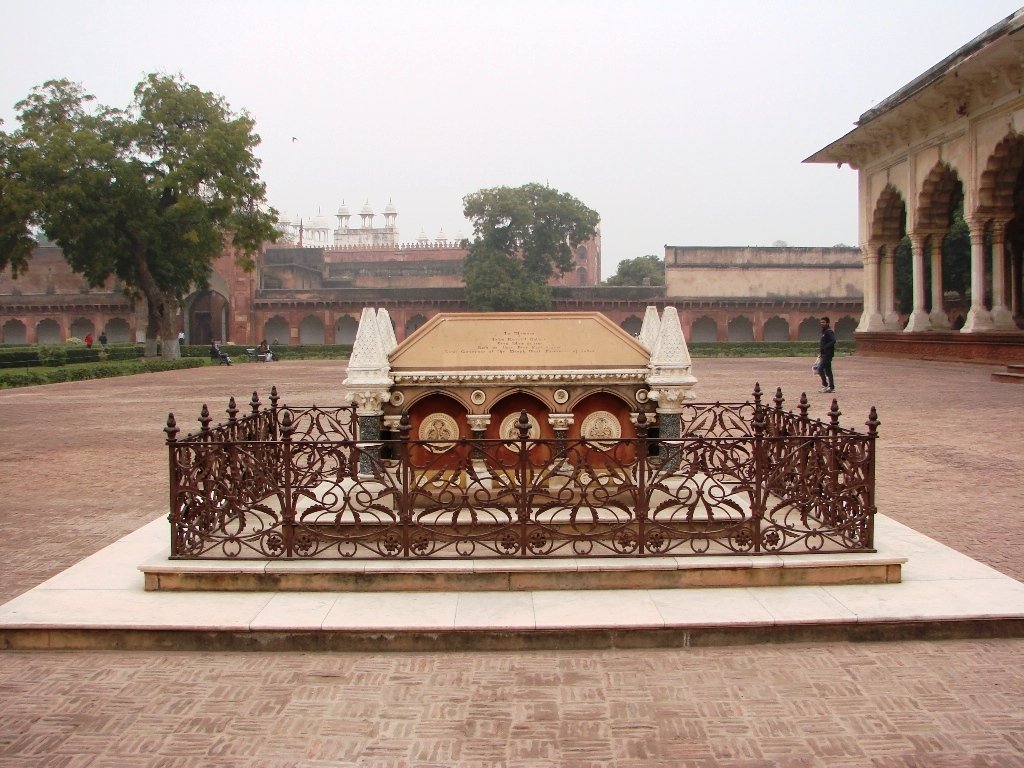
problems. In the paved area in front of the Diwan-i-Am is a large well
and the tomb of Mr John Russell Colvin, the Lieutenant Governor of the
Northwest Provinces who died here during the 1857 ‘Uprising’.
Stylistically it is sadly out of place. The yellow buildings are
barracks build during the British period and closed to the public.
Tell us what you think. Are you heading to Agra Fort or have
you visited this attraction before? Do you have any interesting facts or
tips about Agra Fort you would like to share?
We love to hear from you so please leave your comments below.